
The Bureau of Internal Revenue’s (BIR) Revenue Memorandum Circular (RMC) No.132-2024, issued on December 8, 2024, brought welcome clarity on how thePhilippine Amusement and Gaming Corporation (PAGCOR) and its gaming ecosystem are taxed. Under the Circular, PAGCOR and its Licensees and Contractees pay only the 5% Franchise Tax on income from gaming operations - in lieu of all other national and local taxes, including Corporate Income Tax (CIT)and Value-Added Tax (VAT).
For Operators — the casino, iGaming, and bingo licensees at the front end of the gaming business — the position is now settled.
The Gap It Left Open
But there’s a gap worth addressing. RMC 132-2024’s clarification is squarely aimed at Operators. It does not expressly cover the wider business-to-business (B2B)layer that PAGCOR also accredits: Game Aggregators that integrate and distribute game libraries, Game Content Providers (GCPs) that develop slots andlive dealer titles, and Support Service Providers that deliver electronicKnow-Your-Customer (e-KYC), payments processing, anti-fraud systems, and player account management solutions.
Each of these entities sit inside PAGCOR’s jurisdictional perimeter — yet theCircular’s ‘in-lieu-of’ language stops at the Operator.
A Product of Sequencing, Not Design
Part of the reason for that silence is timing. When RMC 132-2024 was issued, therewas no clear regulatory framework yet governing B2B providers under PAGCOR. TheCircular addressed the categories that existed and were well-defined at the time — PAGCOR, its Licensees, and its Contractees.
The B2B licensing layer has since matured. The tax guidance has not kept pace. This gap is a product of sequencing, not a deliberate carve-out.
The PAGCOR Charter designed the Franchise Tax as a clean, single-layer tax on the gaming industry — not one that fractures along the value chain. Extending it to accredited B2B providers is consistent with that intent.
The Case for Inclusion
These B2B providers are not third parties on the outside looking in. They are PAGCOR-accredited entities, subject to the same regulatory regime as the Operators, and their revenue flows directly from gaming operations. Without them, Operators simply cannot run their business.
Extending the in-lieu-of-all-taxes treatment to accredited B2B providers is consistent with the intent of the Presidential Decree (PD) No. 1869 — the PAGCOR Charter — which designed the franchise tax as a clean, single-layer taxon the gaming industry, not a tax that fractures along the value chain.
Operators are already inside the 5% franchise tax regime under RMC 132-2024. PAGCOR-accredited B2B providers are functionally similar — licensed, regulated, and paid out of gaming revenue. Treating them differently creates arbitrary tax outcomes based not on what a company does, but on where it happens to sit in the supply chain.
The Upside
The practical benefit is straightforward. B2B providers would pay only the 5%franchise tax on gaming-derived income. That means a level playing field across PAGCOR’s ecosystem and a real incentive for foreign-based B2B providers with deep technical expertise to establish operations in the Philippines.
The country gains the technology, talent, and capital. Operators gain mature, specialized partners. The tax base remains intact.
BIR Clarification Needed
What is needed is an express clarification from the BIR confirming that the 5% FranchiseTax regime under RMC 132-2024 extends to PAGCOR-accredited B2B providers. A clarificatory RMC would close the gap and send an unambiguous signal: if you are PAGCOR-accredited B2B provider, the franchise tax applies to your gaming operations.
###
Sua Mundir is a Philippine-qualified lawyer and legal counsel at Arden Consult. He advises local and international clients on market entry, regulatory compliance, and strategic partnerships across the iGaming, fintech, and BPO sectors, specializing in corporate law, immigration, and intellectual property. He graduated with honours from the Ateneo de Manila University School of Law.
Read the Philippines Chapter on Gaming Law 2025 here

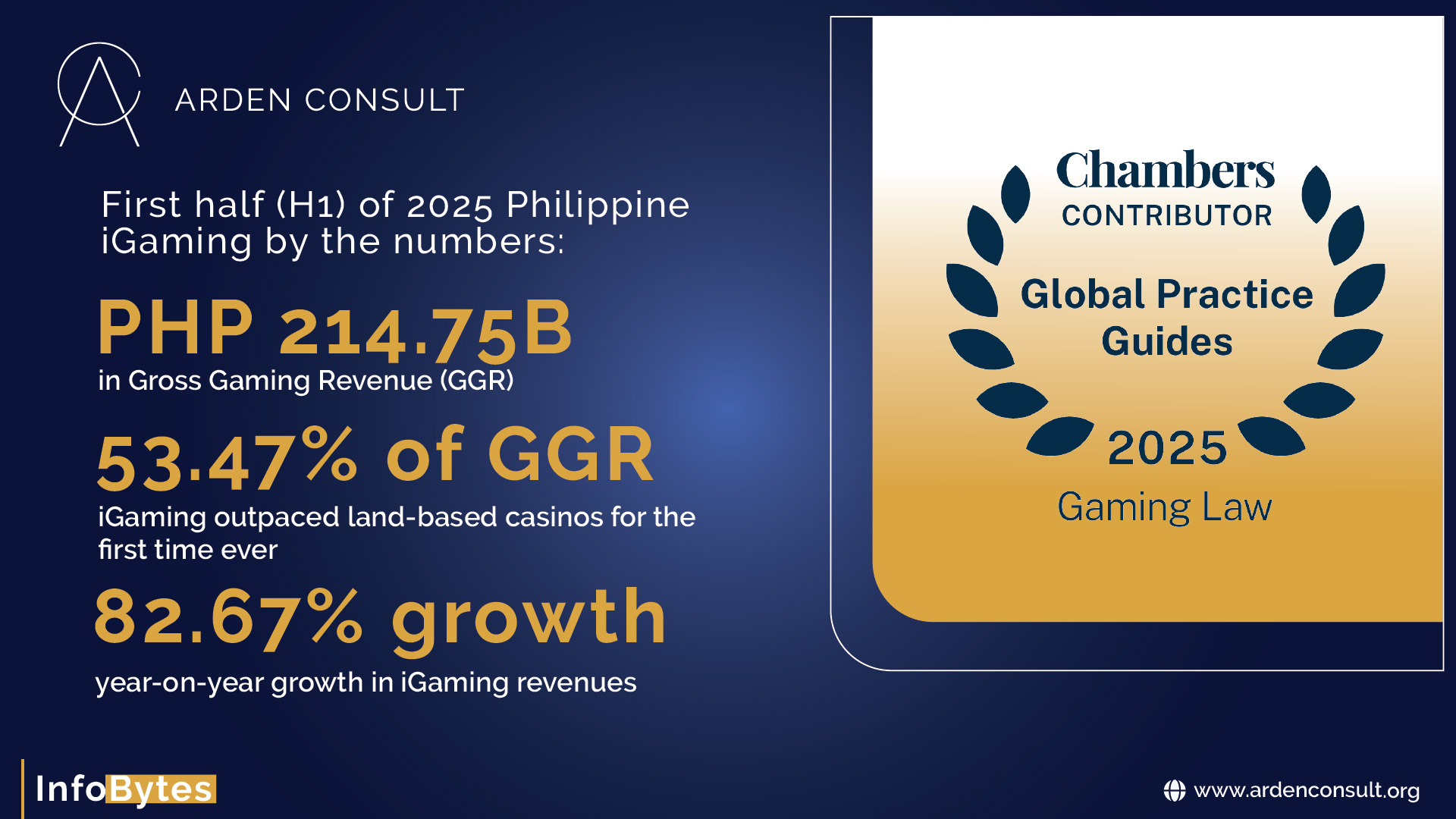
Arden Consult authors the Philippines Chapter in the Chambers and Partners Global Practice Guide: Gaming Law 2025